
In her acceptance speech accepting her honorary doctorate from NMMU, Geraldine Fraser-Moleketi said:
“A giant who strode the globe like a colossus has fallen. A mind whose thoughts have opened the doors to our liberty has ceased to function. A heart whose dreams gave hope to the despised has forever lost its beat. The gentle voice who measured words of reason shook the thrones of tyrants has been silenced… Dear brother you set yourself a task which only the brave would dare. Somewhere in the mystery of your essence, you heard the call that you must devote your life to the creation of a new South African nation….” As I address this convocation These words of Nelson Mandela at Oliver Tambo’s funeral on 2 May 1993 is as pertinent today, as it was at the time, as I am conferred the Honorary Doctorate from the Nelson Mandela Metropolitan University
Nelson Mandela, OR Tambo, Govin Mbeki, Raymond Mhlaba, Walter Sisulu, Ray Alexander, Reggie September, Alex La Guma, Albertina Sisulu, Raymond Urin and many others of their generation, inspired me as a girl and a young woman to join the struggle for social, political and economic justice in all its facets. I was informed by the vision to build a nonracial, nonsexist society;
The values, of these leaders, allowed a young girl born on the Cape Flats to a working class family, teacher father (hailing from Tsomo in the Transkei) and factory worker mother (KIipfontein, Cape Town) to dream ‘audacious dreams’. My trade unionist maternal grandmother (Mabel Pinto) would never have dreamt that her eldest granddaughter was to hold public office as Minister of Welfare and Population Development and later Minister of Public Service and Administration. My grandfather, Richard Fraser, who refused to be moved to Elsies River in Cape Town when Transkei was declared a Bantustan – he said “reclassify me if you so wish” – would not have imagined me as the Director of the Global Democratic Governance Practice of the United Nations Development Programme based in New York or as Special Envoy on Gender of the African Development Bank most recently based in Abidjan, Cote d’ Ivoire.
Allow me to touch on public service and its importance especially in view of my tenure in this portfolio.
Public Administration and Public Service is critical
It is important to have a well functioning state: important to build enduring public service institutions and systems, attract and build our human capital – a strong cadre of public servants who are ready to serve in all echelons, sectors and arms of government;
the public service must always be above party political interests and not be drawn into factionalism; the Freedom Charter unequivocally states “the people shall govern”; Not a section of the people but the people…
Section 195 (1) (d) of the Constitution states: “Services must be provided impartially, fairly, equitably and without bias.” We must engage those who differ from us; we must involve all stakeholders; we must not serve factional agendas;
It must be stressed that strong public service is not a foreign concept.
Our committed Public Servants are those police men and women who leave the comfort of their homes to act in the protection, defence and interest of the public; the paramedic who goes into the most difficult areas to tend to accident victims, and in instances victims of gang wars, save lives in emergency situations along with members of the emergency services; the teacher/educator who does extra lessons on Saturdays without extra remuneration; the teacher who skills her or himself after hours in order to be a better educator; the doctor and the health workers in our public health facilities – that is public service – living the values of the generation of Nelson Mandela, OR Tambo and others who placed public service first;
- we must be intolerant of those who do not serve the people;
- we are painfully aware of the instances when there have been deviations from the noble mission of public services for, and in the interest of the public, and in our recent collective memory, Marikana comes to mind.
I would like to recognize the generation of Rhodes must fall, “Fees Must Fall” and the Pretoria Girls high school activists. Your engagements lives the reality that Prof Joseph Stieglitz reflects upon “equality of opportunity”, (in his book, “The Great Divide”) “another way of looking at equality of opportunity is to ask to what extent the life chances of a child are dependent on the education and income of his parents. Is it just as likely that a child of a poor or poorly educated parent gets a good education and rises to the middle class as someone born to middle-class parents with college degrees? Even in a more egalitarian society the answer would be no…” These are the issues you and all of us are and should be grappling with. It is a reality for the child in this area in which the NMMU. Let it be a constructive discourse, as you remind us that you, the millennials and post millennials, are not only prepared but willing to lead this country in achieving the future that leaders of yester-year envisioned, and this is how it should be!
the “people shall [indeed] govern” and this requires leadership, public accountability and transparency with a clear commitment to fight corruption and uproot it where it exists;
It is significant that the graduates of NMMU will live the legacy of Nelson Mandela to a greater degree since this is and will be THE university in the world that carries this great name; Furthermore, it is not only what the university can provide to students but what students bring to the university that is just as important. Student activism, organization and mobilization is crucial in the development of an inclusive society.
The pride of NMMU includes that it will be the leading “go to” destination for Ocean Sciences in Africa with the new dedicated campus to be launched in September 2017. As you are well aware, our planet is predominantly covered by massive oceans that play a major role in driving climate and it ecosystems; it is not by accident that Nelson Mandela University will lead in this area providing women and men opportunities to develop careers and create jobs;
I started with the words of a “global colossus” and let me conclude with the much quoted words of Nelson Mandela “I have walked that long road to freedom I have tried not to falter; I have made missteps along the way. But I have discovered the secret that after climbing a great hill, one finds that there are many more hills to climb….But I can rest only for a moment, for with freedom come responsibilities and I dare not linger, for my long walk is not yet ended.” I am greatly honored to receive this doctorate in the year that NMMU will officially become Nelson Mandela University.
Thank my family: Jabu, Nothando and Bradley , Themba, Solomzi …thank The Fraser’s – my late father would have been so proud, my mother and siblings. I am humbled to accept the degree of Doctor of Philosophy (Honoris Causa) by the faculty of Business and Economic Sciences. ” the long walk to freedom” has not ended.
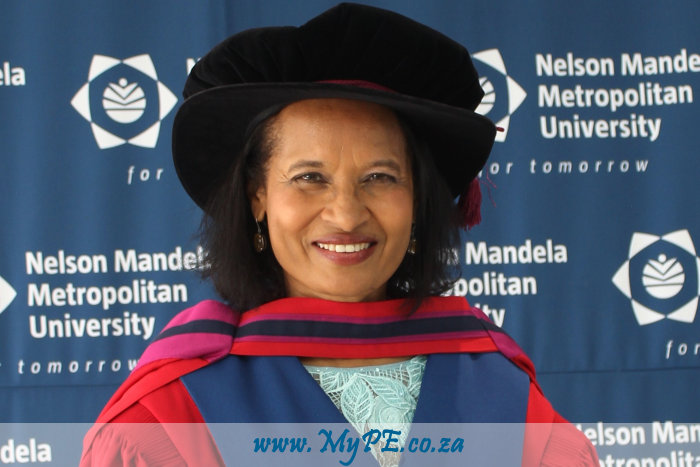
Geraldine Joslyn Fraser-Moleketi is a strong and passionate leader working towards the continent’s social and economic transformation.
She was born on the 24th of August 1960 in Cape Town and lived with her grandmother in Cross Roads on the Cape Flats during the week in order to attend Livingstone High School in Claremont where she matriculated. Weekends were with her parents in Faure near Stellenbosch where her father was principal of the State Children’s Home.
In 1980 when Geraldine was in her second year at the University of the Western Cape, she joined the African National Congress (ANC) and left South Africa to go into exile in Zimbabwe, Zambia and Angola. She returned to South Africa in July 1990 when the South African Communist Party (SACP) was unbanned. That same year she was elected to the SACP’s Central Committee and served as Deputy Chairperson of the SACP from 1998 – 2002 – the first woman to hold that position.
Geraldine holds a Master’s Degree in Administration from the University of Pretoria. She is a fellow of the Institute of Politics, Kennedy School of Government at Harvard University and holds an honorary professorship at Stellenbosch University.
Geraldine’s democratic era achievements include playing a key role in preparing the ANC for the first democratic elections in 1994 as National Deputy Elections Coordinator. She was elected to South Africa’s first democratic parliament in April 1994 and served in three consecutive parliaments until her resignation in September 2008 – being Deputy Minister of Welfare and Population Development (1995 – 1996), Minister of Welfare and Population Development (1996 – 1999) and Minister of Public Service and Administration (1999 – 2008).
Geraldine serves on various boards across academia, government and development organisations. These include serving as a Board Member on UNITAR (United Nations Institute for Training and Research) and as Deputy Chair of the United Nations Committee of Experts on Public Administration. She has also served as Director of the United Nations Development Programme’s Democratic Governance Group. She is on the Advisory Board of the Institute for the Study of International Development (ISID) at McGill University, Montreal, Canada, and a member of the Advisory Council of the Mapungubwe Institute for Strategic Reflection (MISTRA).
As the Special Envoy on Gender at the African Development Bank from 2013 to 2017, she led a strategy to mainstream gender in the Bank’s policies and operations. She has championed women’s economic empowerment and financial inclusion and has worked in inter-governmental structures, interacted with political leaders, business leaders and civil society.
Her career is characterised by commitment to sustainable, inclusive development and economic growth. She has received several awards including the OP Dwivedi Public Service Award from the International Association of Schools and Institutes of Public Administration, and a Special Award for Outstanding Achievement from University of Pretoria’s School of Public Management and Administration. She has always been actively involved in community work and has served as a patron of Free and Open Source Software for Africa (2007 to present). In 2016, she was named “New African Woman of the Year” as “one of the most influential women of the continent, paying tribute to all those who are changing the game in Africa and beyond.”
A strong supporter of intergenerational dialogue, Geraldine is a mentor to young women and men across the continent on leadership and resilience, to enable them to play their part in determining Africa’s destiny.
For her contribution to leadership in social and economic transformation with the specific emphasis on the empowerment of women, it is an honour for Nelson Mandela Metropolitan University to confer the degree of Doctor of Philosophy (honoris causa) on Geraldine Fraser-Moleketi.


Alan Straton
Latest posts by Alan Straton (see all)
- The Gold Avenue Prices Half, Quarter and Tenth Ounce Krugerrands One by One - 17 November 2026
- Nifty Gifts Helps South Africans Get ahead of Christmas Shopping Online - 16 November 2026
- The Diamond Box Helps Couples Plan a Summer Holiday Proposal Online - 16 November 2026
- For Holidaymakers on Dialysis, December Planning Starts Now, Says Mbombela Travel Planner - 16 November 2026
- Durban Print Room Replaces the Broken Part, Not the Whole Display - 16 November 2026
