
Deepening inequality is the high price students will pay for free education by Nelson Mandela Metropolitan University:
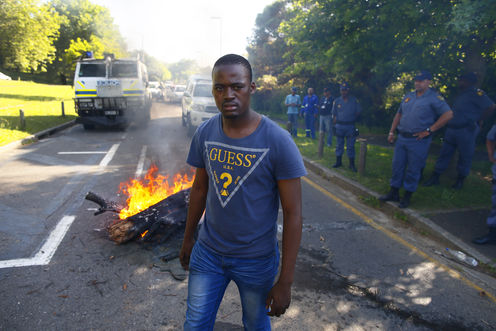
University students have scored some massive victories since “fees must fall” entered South Africa’s lexicon. They have secured more government funding for fees. They have forced universities to address a complex range of institutional inequalities.
This #FeesMustFall movement has become a force for social change centred around access to and free tertiary education. It demands deep transformation in all sectors of the higher education landscape and, in essence, encompasses broader societal issues of social justice and equality.
The gains students have made don’t just hold the government and university management accountable. They also speak to the “will of the people”, the public good, and robust democratic processes in South Africa.
But herein lies the problem: transformation, or social change, has a dynamic of its own. This makes it an unpredictable, uncontrollable and unknowable force – one with often unintended consequences.
The law of unintended consequences
Psychology professor Robert Kurzban likes to tell the story of what happened when bubonic plague reached an Australian neighbourhood, The Rocks, in 1900. Rats carry the fleas that transmit the plague to humans. Local authorities offered a reward to residents for every rat killed. The unintended consequence? People tempted by this bounty actually started breeding rats.
This illustrates that when people effect social change by intervening in complex, dynamic systems with many parts, especially economies, it disrupts the complex web of interrelationships. This has unforeseen and unforeseeable consequences that are not anticipated by politicians or popular opinion.
So what’s the unintended consequence of the #FeesMustFall movement’s victories? Quite simply, the substantial resources universities must direct at fee shortfalls in both the immediate and long term will become increasingly problematic for government and the ailing South African economy.
The psychology of scarcity
These resource struggles are going to impose critical limitations on universities’ academic projects. Efforts will be concentrated on maintenance, and even survival, rather than growth and advancement.
Universities started the 2016 academic year talking about scarcity. The dominant discourse centres on budget constraints, post freezes, arrested projects, salary containment, affordability reviews – that is, whether courses are viable and sustainable – third-stream income and rising university debt.
The “scarcity mindset” is a significant area of behavioural research in economics, psychology and public policy. It highlights the adverse impact of scarce resources like time and money on mental states and social and physical environments. Scarcity is all-consuming. It imposes cognitive deficits and activates destructive emotional states of anxiety and fear.
It also narrows the worldviews of individuals and institutions, creating a myopic concentration on immediate gains. There’s no room in this tunnel vision for creative problem solving, innovative planning and deliberate decision-making.
Universities are spaces where the freedom of critical enquiry, expression and debate are fundamental principles. In the words of Oxford University’s Chancellor Lord Patten of Barnes, nobody wants them to become:
… a drab, bland, suburb of the soul where the diet is intellectual porridge.
Free education or quality education?
Now South Africa’s universities are tightening their belts at a time when they actually need more resources to address the extensive teaching and learning challenges of a deeply divided society.
Universities ought to be involved in a range of innovative, professional teaching, learning and research activities. They can do important work in areas like curriculum design, educational technologies, sustainable infrastructure, internationalisation and technical support.
They are also expected to produce global, critical thinkers. These graduates can contribute to a knowledge society, drive the economy and enhance democratic citizenship. Universities that narrow their focus to make ends meet and have only scarce resources cannot fulfil these important roles.
Scarcity means that some academic goals will have to be sacrificed at the expense of others. Universities, which are already dealing with a multiplicity of competing needs and demands, will now be under pressure to choose how and where they allocate scarce resources.
Educationalists have warned that these relentless, growing pressures may lead to a “quality collapse”. These are the unforeseen consequences of the #FeesMustFall movement’s demands and gains.
Collateral damage – the trade-off
Students actually risk becoming collateral damage if this climate of scarcity forces a trade off between quality education or free education. They’ll be the unintended targets of discriminatory and exclusionary practices amid a crisis in higher education.
Graduates without the requisite knowledge, skills and values will not have access to the competitive “world of work”. And this will further entrench inequality and injustice in South Africa.

Lyn Snodgrass does not work for, consult, own shares in or receive funding from any company or organization that would benefit from this article, and has disclosed no relevant affiliations beyond the academic appointment above.
Read more here: http://theconversation.com/deepening-inequality-is-the-high-price-students-will-pay-for-free-education-54350.

Port Elizabethan
Latest posts by Port Elizabethan (see all)
- Why Fewer People Are Being Convicted for Commercial Crimes - 15 May 2026
- Urgent Call for South Africa to Support and Join Global Efforts to Phase Out Fossil Fuels - 15 April 2026
- Unfenced 6 SAI Army Base Outside Makhanda Claims Another Life - 20 November 2025
- Death Toll Rises From Makhado Bus Crash - 21 October 2025
- Law Clinics Flooded as Home Affairs Blocks Asylum Seekers From the System - 15 October 2025
