
The Coega Development Corporation (CDC) is making good on its promise to roll out driver training in the Eastern Cape through state-of-the-art simulators with two big handovers planned for this week.
The Eastcape Midland and Port Elizabeth Further Education and Training (FET) Colleges are the first higher education institutions in the Nelson Mandela Bay area to benefit from the programme. The latest move brings the total number of participating institutions in the Eastern Cape to seven.
To date the CDC has provided its driver training programme at five institutions around the Eastern Cape: Walter Sisulu University, FET colleges Ikhala, Buffalo City and Ingwe, as well as the University of Fort Hare.
The driver simulator-based training is the initial step of the programme and affords first-time drivers the opportunity to learn in a safe environment before venturing out onto the road.
“Young people who have an education often lack basic essential skills, like driving, limiting their access to the job market,” said Vilakazi. “The CDC wants to ensure young people have access to this world-class driver training programme that both provides crucial skills and enables employability,” said Ayanda Vilakazi, CDC spokesperson.
“The move to place driver simulators at the Eastcape Midland and Port Elizabeth Colleges is based on the fact that we want to enhance the reach and impact of the driver training in the city. We envisage Nelson Mandela Bay boasting some of the best drivers in the country as a result of this programme.”
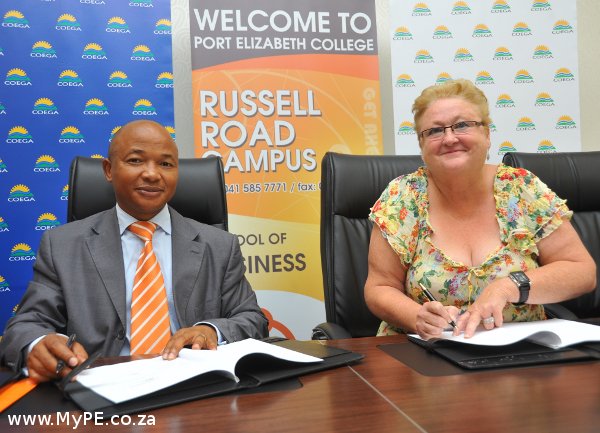
The handovers of the simulators took place at PE College today and EC Midlands on Wednesday.
According to Therina Pienaar, Registrar for Planning, Research and Partnerships at the Port Elizabeth FET College, this training opportunity will open the employment door to many of their students, as drivers licences are often a pre-requisite when applying for positions.
“Most of our students come from disadvantaged backgrounds and cannot afford the luxury of paying for drivers classes, so these mobile units are really going to be of tremendous benefit -not only for our students but also to us as an institution as we always strive to empower our students and give them the best possible start into the world of work.”
Eastcape Midland College Career Development Centre Manager Roxy Roodt said access to the driver simulator will form part of the critical resources needed for further student training and development which is directly linked to student employability skills for industry.
“Eastcape Midlands College is particularly excited about this project as the simulated driving training programme will be piloted at the Brickfields Road campus as well as the Grahamstown campus,” said Roodt.
“We expect that students will gain a safe and realistic experience of the driving process, and also be able to improve their own driving ability, at the same time enhancing their employability skills.”
The driver simulators are compliant with the K53 driving curriculum, and cover the modules of identification of components, pre-trip inspection, starting procedures, moving-off and changing gears, handling of vehicle (hand-eye co-ordination exercises), parallel parking, alley docking, turn in the road, incline start, highway driving (with different weather conditions), city driving in basic and advance mode and a yard summary.
A progress report is also generated after the completion of each module for the benefit of the user of the driver simulator. Drivers are trained for a Code 8 licence. Simulator training is followed by on-road training under the guidance of trained instructors.
The CDC is on a mission to extend beyond the province into other tertiary institutions around the country. It also is facilitating the sale of the simulators to private organisations after signing an agreement with the driver simulator company, Afsim, to become the sole South African distributor of the driver simulator machinery.
Last week the CDC sold 10 driver simulators to the South African military in Pretoria for training purposes.
“The momentum behind both sales of the driver simulators and our collaboration with instititions of higher learning show that the demand for training – and drivers licences – is incredibly high. We are happy to be spearheading this project which ultimately facilitates socio-economic development, as trained people are more able to particpate meaningfully in the economy,” added Vilakazi.


Alan Straton
Latest posts by Alan Straton (see all)
- SAFRA Marks 15 Years and Nearly 500,000 Moving Quotes - 19 October 2026
- SAFRA Unveils Exciting Website Upgrade for Easier Moving Quotes - 19 October 2026
- SAFRA Launches Powerful New Furniture Volume Calculator - 19 October 2026
- What Parents Need to Know about Polio - 19 October 2026
- Rodent Checks Should Include the Parked Car, Says Gqeberha Pest Control Operator - 19 October 2026
