
The Port Elizabeth Museum at Bayworld is the third oldest museum in South Africa.
The Bayworld complex is unique in Southern Africa as it embraces a natural and cultural history Museum combined with a Snake Park and Oceanarium. It is located in the heart of the Port Elizabeth beachfront and serves up a feast of edutainment to hundreds of thousands of visitors each year.
The main activities of the Complex are research and education aimed at stimulating a greater awareness of the need for conservation of South Africa’s natural and cultural heritage. Research and education programmes focus on marine life, reptiles, maritime and local history.
Opening times: 9:00-16:30 (Daily, except 25 December)
Presentations are not guaranteed.
- Seal & Penguin presentation – Monday to Friday at 11:00
- Seal & Penguin feed and commentary – Weekends at 11:00, Daily at 15:00
- Snake Interaction – Daily at 12:00
- Current entry fees – Adults: R40.00, Children (3-17 years): R30:00, Pensioners or Students: R35.00
PE Museum
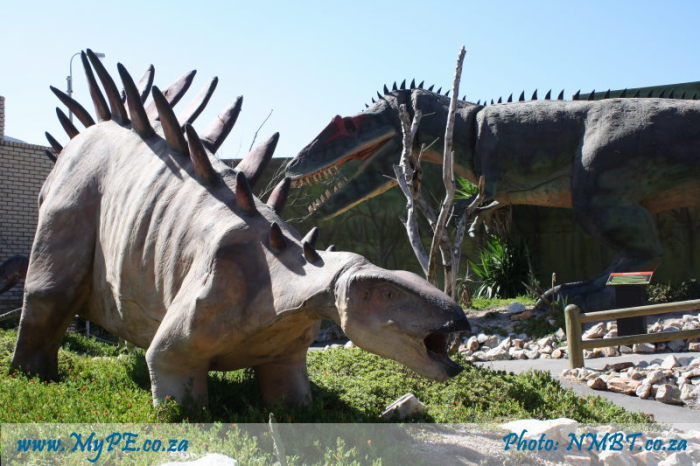
The Port Elizabeth Museum, which blends cultural with natural history, is the third oldest in South Africa and is the parent unit of Bayworld. The museum consists of a Dinosaur, Marine, Bird, Maritime History, Costume and Local History Halls, as well as a Curiosity Corner, Xhosa Beadwork Gallery andthe First People of the Bay exhibit. Other diverse temporary exhibits in the fields of natural science, archaeology and geology are also regularly on display in the Museum.
Particularly noteworthy exhibits are the 15m skeleton of the last Southern right whale harpooned in Nelson Mandela Bay; a life-sized reconstruction of the giant local prehistoric dinosaur known as Algoasaurus; a replica of the Dias Cross; and a 5m bronze cannon dated 1640, recovered from a Portuguese galleon wrecked near Port Elizabeth.
Snake Park
Reptiles tend to inspire either fear or fascination. The Bayworld Snake Park, which has been in existence since 1919, houses various reptiles, many of which are indigenous to the Bay area. The collection includes the longest species of snake in the world, the snake species responsible for the most deaths in Africa, a snake species that plays dead as a defense technique as well as some of the common species which you might find in your back garden while in the Bay.
The signage will help you identify the various species so if you do bump into one of them, you know whether it is dangerous or not! So, whether you are facing your fear or feeding your fascination, come and see the various snakes, lizards, crocodiles, tortoises and terrapins that we have on display.
No 7 Castle Hill
Situated in the city centre, No 7 Castle Hill is a Victorian house museum dating back to 1827. The house is a declared National Monument.
This picturesque cottage is one of the oldest remaining dwelling houses in Port Elizabeth and is furnished as a family home of the mid-Victorian period, depicting the early Settler way of life.
Staff will provide general tours or special interest tours on request. To arrange this, please contact +27 (0)41 582 2515.
History
In 1856 land was granted to the Municipality for the erection of a Town Hall, municipal offices, library and Athenaeum. A small room was set aside in the Athenaeum for the collection of unusual natural history specimens and the following notice appeared in the Eastern Province Herald of 2 September 1856:-
Port Elizabeth Athenaeum Patron: His Excellency, the Governor
A museum having been commenced in connection with this society, contributions addressed to the care of the Secretary will be thankfully received and acknowledged.
By Order of the Committee
W.Selwyn, Honorary Secretary
Port Elizabeth September 2 1856.
The response was apathetic and it was only in 1885 that the Museum acquired new premises in a room behind the Feathermarket Hall. It took a further twelve years before the institution became known as the Port Elizabeth Museum in 1897, with Mr Marshall as the first Curator.
In 1906 the somewhat badly run Museum received a welcome boost with the appointment of the dynamic Mr FW Fitzsimons as Director. He re-organised and extended the displays and soon had 7000 residents of the sleepy town of Port Elizabeth attending his “Popular Nights”, where the Museum offered exhibitions of live snakes and magic lantern shows. The collections expanded and rapidly outgrew the allocated space.
It was with relief that in 1919 the Museum was able to move to the luxurious mansion in Bird Street, bequeathed by AW Guthrie. The Snake Park opened in the spacious grounds – the first of its type worldwide. Demonstrations by snake handler, Johannes, were immensely popular. He is reputed to have been bitten on average once a year for the 30 years he was on the staff, eventually dying of old age!
In 1933 a newly constructed Seal Pool opened, but the smell and guttural bickering and barking at night intruded on the lifestyle of the elite residents of Bird Street. Following a court case, the pool closed and the seals were banished.
During World War II, under the Directorship of Dr John Pringle, the museum played a pivotal role in supplying snake serum to the SA Institute for Medical Research to be used by the Allied Forces serving in snake-infested areas of Africa.
In 1942 the Museum School was established, bringing a new, exciting method of education to many. Specimens, contained in suitable boxes, were lent to schools to further pupils’ knowledge of animals, plants and cultural objects.
Great excitement was generated in Port Elizabeth when King George VI of Great Britain and his family visited the Museum and Snake Park in 1947 on their Royal tour of South Africa.
The foundation stone of the present Port Elizabeth Museum Complex was laid on 11 November 1958 with the new Snake Park being constructed and opened a year later during Dr Geoff McLachlan’s tenure as Director. The transfer of all museum specimens from Bird Street to the new buildings on the beachfront included the large whale skeleton presently on display in the Marine Hall – a monumental task.
Dr John Grindley was the incumbent Director when the charming Georgian house museum in Central, No 7 Castle Hill, was incorporated into the Museum Complex in 1968. During that year too, on 12 December, the Dolphin Lake was opened with dolphin Dimple obligingly producing a calf that very morning. Dolly was christened after a nationwide competition to select a name. She died in February 2005 at the age of 37 years and was believed to be the oldest surviving dolphin conceived and born in an Oceanarium anywhere in the world.
The Tropical House, with its wonderful plants, bird life/flamingoes, crocodiles and Night House with nocturnal animals such as nagapies and owls, opened to the public in 1972. The striking murals on the exterior of the building were created by Port Elizabeth sculptor, Phil Kolbe.
During Dr John Wallace’s period as Director, the education and research sectors of the Museum expanded rapidly with new classrooms, office space, laboratories and storerooms being built. The Museum shop and Ice-cream Parlour came into being and the Snake Park acquired a modern entrance. An innovative and immensely popular Children’s Touch Museum was established in the small, redundant Old Post Office building across the road from the main complex. The Shipwreck and Maritime History Hall was opened in 1986 and won acclaim as the best of its type in South Africa.
Research in dinosaur paleontology, sharks, marine mammals, maritime archaeology, local history and herpetology progressed apace during Dr Mike Raath’s term as Director. Computers were introduced to all departments and rapid progress was made in the technological field. He oversaw the transition to the new democracy in 1994 and was fully involved in endeavouring to keep museums to the forefront in the new regime.
Mrs Sylvia van Zyl became Director in 1996. The courtyard and amphitheatre were built as part of an RDP project and a ramp for the disabled was incorporated into the present Museum building, utilizing courtyard space. Progress was made in transforming Bayworld staff and Board of Trustees to be more representative of the population dynamics. The diverse and colourful Costume Hall, opened in 1997, depicts the vibrancy and diversity of the rainbow nation and has proved popular with the public. An exhibition on Sharks – Magnificent and Misunderstood was opened in 1999.
Many temporary displays addressing current issues have since been hosted. These have included Triumph over Adversity – a collaborative exhibition with organisations involved with the disabled, the extremely emotive Robben Island Reunion exhibition which tells the story of Robben Island since its discovery by Bartolomeu Dias in 1488, through its dark days as a maximum security prison, culminating in the release of Nelson Mandela and other detainees in 1990, the Umcebo Banner Project – a series of themed banners made by mentally handicapped learners from Ningizimu School for the Severely Mentally Handicapped in Durban, Keiskamma Cream Tapestry depicting the history of the Eastern Cape over 100m of vivid and expressive embroidery and beadwork and a photographic exhibition by Dr Peter Magubane entitled Madiba: Man of Destiny
Bayworld is now facing an exciting future with a modern facelift in the pipeline. The proposed redevelopment will ensure a world class visitor attraction with a totally unique experience of the “World in the Bay, and the Bay in the World”.
More Must See in PE suggestions.
CLICK HERE for: Budget PE Accommodation | PE Waterfront
Experience Magnificent Nelson Mandela Bay:


Alan Straton
Latest posts by Alan Straton (see all)
- The Household Pest Mystery That Starts in the Roof - 25 October 2026
- The Holiday Souvenir Nobody Wants: Bed Bugs in the Luggage - 25 October 2026
- What Comes Out of a Rug Before the Washing Starts? - 25 October 2026
- Desktop Pop-Ups Become the Compliance Channel Email Cannot Deliver - 23 October 2026
- Desktop Pop-Ups Become the Compliance Channel Email Cannot Deliver - 23 October 2026
